newlyn
Saturday 21st March - Monday 13th April 2009
selected works
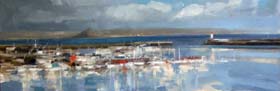 |
Myles Oxenford Mounts Bay from Newlyn Harbour oil on board 20 x 60cm £895
Newlyn For the more observant much of Newlyn’s history can be deduced from sight- reading the curving 14th century granite wall of the original small harbour, an edifice all too easily overlaid by the bustle of the present. A deeper reality lies hidden with a knowledge of this village, important centuries before Penzance even existed, when the Bay boasted three shelters from the storms of Lands End, the harbour of St Michaels Mount, Mousehole and Newlyn, each of which mirror in their own way centres of trade, boat building skills and, of course, fishing. Newlyn was separated into two parts with the high curve of North Corner dividing them. Fish were sold on the beach at low tide, together with their gutting and boxing and the maintenance of the luggers. This filthy, smelly life remained exposed to the ocean, the wind and the weather and its population was entirely vulnerable to heavy gales from the east. Newlyn’s native population may be almost as insular today as it was centuries ago but, paradoxically, their livelihood is dependent on the fact that this village has successfully managed to develop important trams- European trading connections. This achievement is maintained largely behind the scenes with the same determination, rigour and persistence that made Newlyn a success in earlier days. The factor that causes Newlyn to be unique in the context of Cornwall as a whole is that the port does not doff its cap to tourism, that plague of misplaced hopes which has written the death sentence to less hardworking harbours around the coast. In its stead, Newlyn’s story is encapsulated by the triumphant sight of its harbour full of shipping, adjacent offices and the busy pubs pulsing with life. It is the archaic nature of this ancient port which has for so long attracted painters, it is up to us now to carry on the responsibility of portraying Newlyn. How to fittingly transcribe afresh hulls old and new alongside its powerful atmosphere is indeed a challenging prospect. To achieve paintings without falsity or flash artistic cliché is indeed a daunting and harrowing task. It is one that can only be attempted with the keenest observation allied to an inner knowledge of the place. I would like to congratulate Sarah Brittain for proposing this project, with all its complexities and scope for individual interpretation. Jeremy Le Grice Artists included in this exhibition were simply given the title “Newlyn”. The resultant works portray a fascinating documentation of this historical harbour and village, which under impending regeneration and harbour redevelopment plans, seems likely to soon change dramatically. Some artists chose to depict the boats, harbour and houses of the port whilst others abstracted water reflections or took inspiration from the artistic heritage of Newlyn. It is evident that artists continue to find inspiration in this busy, working harbour following in the footsteps of the Newlyn School and this exhibition is both a celebration of this unique place whilst providing an interesting comparison of contempoary artists to the plein-air painters at the turn of the century. Sarah Brittain, Director, Cornwall Contemporary |
