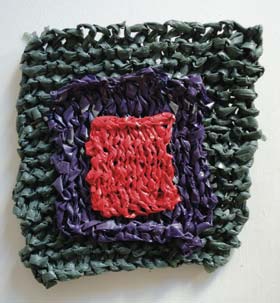
After Albers Homage to the Square IV
15.5 x 14.5cm
knitted plastic £295

This solo exhibition at Cornwall Contemporary by Daphne McClure marks 35 years since her return to Cornwall and the beginning of her remarkable painting career.
A dedicated artist from childhood, Daphne McClure believes that the best thing her parents ever did for her was to send her to Redruth Art School. Born in Helston, Cornwall, she suffered severe asthma attacks as a child and was absent from school for weeks at a time. Whilst at home, her mother always made sure she had crayons and paints and Daphne drew and painted endlessly.
This led to Daphne studying at Redruth, where after just a year, her tutor thought her skilled and gifted enough to be moved to Hornsey School of Art. She studied under John Platt and enjoyed three inspiring and very instructive years studying all forms of art on the foundation course. She still refers to her time there and in particular to Alan Braund, who instilled in her the fundamentals in basic design and structure in painting.
She subsequently attended The Central School of Art and Design to study lithography and textile design. Whilst there, she often attended ballet and opera performances at The Royal Opera House and noticed in the programme credits that part of the production department was run by two girls who dyed and painted the costumes. She immediately felt it was a position she would enjoy. She applied and after initially being told there were no vacancies, was contacted six weeks later, interviewed and accepted. She was enthralled to be starting work in such a prestigious theatre for £10 a week.
She enjoyed the five years she worked at The Royal Opera House immensely and felt privileged to work with famous designers such as Leslie Hurry (The Ring 1954) and John Piper (The Magic Flute in 1956). The costumes that she found most gratifying to work on were by Goncharovas for Diaghilev’s ballet Firebird with Fonteyn and it was during that production that she started to use the resist form of Batik to dye the costumes.
She continued to work in the Batik method after leaving the Opera House and moving to Oxford to get married. Enjoying the process of wax resist and layering the dyes, Daphne had two exhibitions at The Playhouse Theatre in Oxford before returning to Cornwall in 1976 to Porthleven.
Daphne immediately felt inspired to paint the harbour and boats of Porthleven but quickly became frustrated, as all she could see was the iconic painting of the harbour by Peter Lanyon. With Lanyon’s image of Porthleven blocking her
painting process and not allowing her to paint freely, she returned to screen printing fabrics and sold scarves and smocks at Trelowarren and also opened a junk shop at the back of the house. With the proceeds from the venture she took her first cruise up the Baltic to St. Petersburg and saw the Hermitage for the first time which was a huge revelation. On her return, a friend, David Edwards, who was Air Commander at Culdrose, gave her an aerial view of Porthleven and in much the same way that aerial landscapes had such a profound effect on Peter Lanyon, it gave Daphne the starting point she needed to begin painting again.
“There it all was - the great harbour shape cutting out the skyline. I then painted Porthleven for nearly ten years.”
The family moved to a smallholding on Tregonning Hill in 1988 and it was around this time that a comment by Tony Giles influenced the way Daphne began to work.
“He said you had to be very selective in choosing what to paint in Cornwall because wherever you look, there is something to catch your eye and so much of the county has already been painted. So I decided to paint in series which included the Hayle Estuary, Godvrey Lighthouse, St. Ives and then Levant Mine which I enjoyed immensely. No sea or blues, just siennas, pinks, browns and lots of old gantries.”
The Levant Mine series was exhibited at the Jonathan Clarke Gallery in London in 1994, arranged by Wilson Stephens Fine Art. The following year, Daphne was commissioned by the Tate Gallery in St Ives, to design a piece of work to exhibit for its inaugural exhibition.
In 2004, Daphne was approached by Archeus Gallery in Albermarle Street and it was the subsequent exhibition there that was seen by Nicholas Foxwebber, the Director of the Josef & Anni Albers Foundation in Connecticut. He offered Daphne a residency at the Foundation (artists cannot apply for the residency, they are only selected).
“Of course I accepted this amazing opportunity to go to America and I took my daughter Emma with me. We travelled across the Atlantic on the Queen Mary arriving in New York and had a fantastic time. The studios were wonderful, set in 75 acres of woodland and lakes. The Foundation had a superb library and Albers’ painting “Homage to the Square” looked beautiful in the gallery and I became more aware of his theories on basic design and balance and I even used his architects table.”
This new collection of paintings at Cornwall Contemporary are accompanied by vibrant, plastic constructions. Consisting of knitted plastic carrier bags, they are designed to create abstracted squares of pure colour in a direct reference to Josef Albers “Homage to the Square”. The project began as a reaction to the billions of plastic bags which are thrown away each year. It is a testament to Daphne’s vitality and dynamism, that even at this stage of her career, where she has an enviable reputation and her paintings sit in worldwide collections, she still has the urge to experiment and express herself through different methods of working.
Many of the paintings in this new series are unequivocally Cornish and are immediately recognisable as work by Daphne McClure. As much about colour, composition and balance, as they are about a particular place; the furrows in a ploughed field; the balance of a building on horizon; the shape of a field, they contain all that is exceptional about the structure in Daphne’s paintings. Illustrating her accomplishments in technical skill and displaying an expressive handling of the emotional intensity of the subject, her work draws on the rich artistic heritage of Cornwall whilst still maintaining a contemporary and painterly approach.
Sarah Brittain
Director, Cornwall Contemporary
|